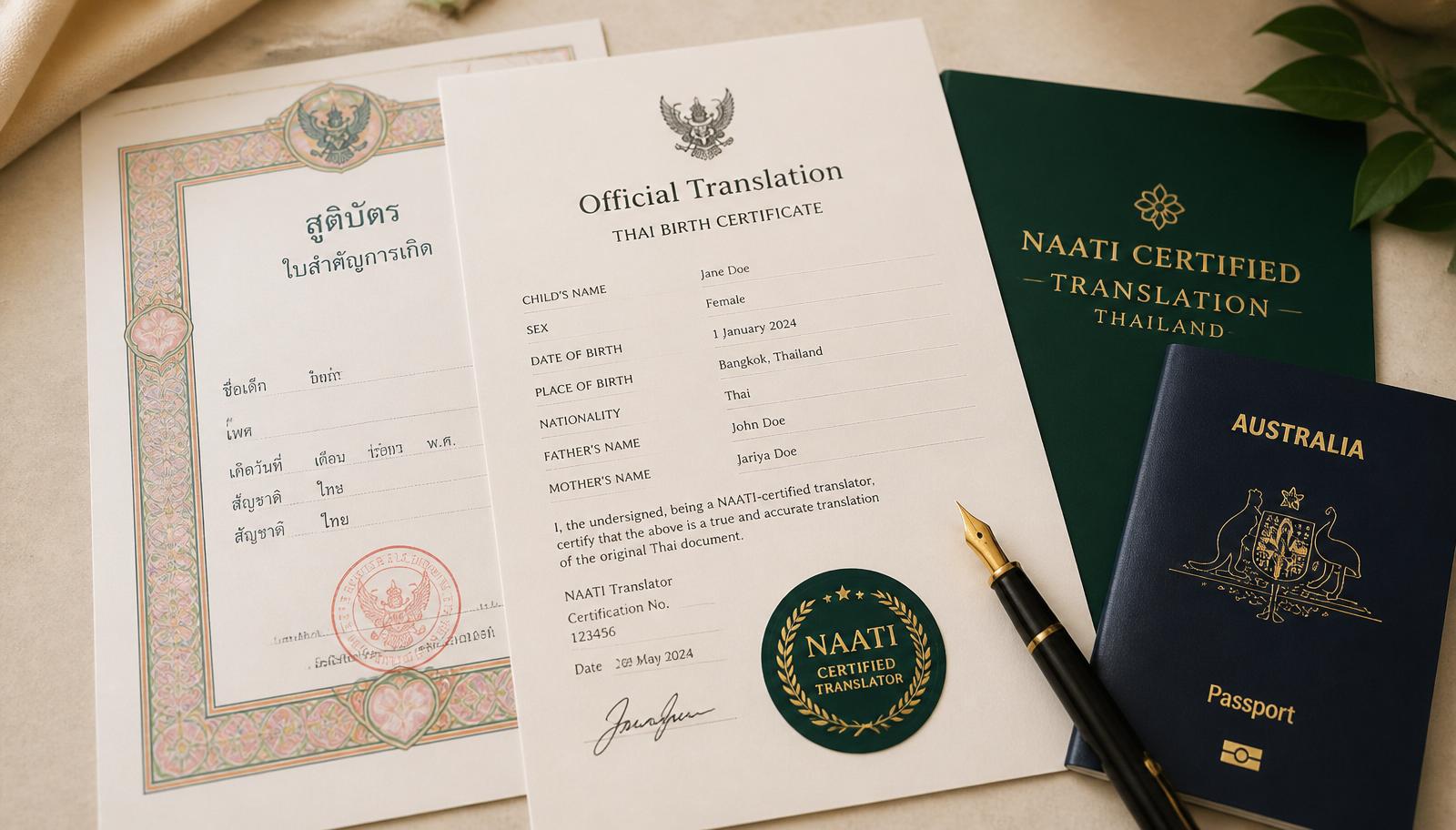
The situation
A typical NAATI Certified Translation in Thailand enquiry reaches us with a deadline already attached — a lodgement date, an employer start date, or a registration appointment. The client has the source documents but not the answer to the only question that matters at that point: which certification layers will the receiving authority actually accept?
Before quoting we check the document set against the destination's current requirements. In files of this type the enquiry usually arrives with either one layer too many (paying for an attestation nobody asked for) or one layer missing (a translation with no consular legalisation behind it).
What we established first
- The exact authority that will receive the document, and the wording it publishes.
- Whether the source record is recent enough to still be accepted on the lodgement date.
- Whether the English spelling of every name matches the passport.
- Whether the 1-3 business days standard turnaround leaves enough margin before the client's deadline.
How NAATI Certified Translation in Thailand actually works, step by step
The workflow below is the one our operations team runs for NAATI Certified Translation in Thailand. It is written out in full because the single most common reason a Thai document is rejected abroad is not translation quality — it is running the certification layers in the wrong order, or adding a layer the destination never asked for.
- Scan review — we confirm every page is legible at 300 dpi and that seals, stamps and handwritten annotations are captured, because a NAATI translator must render everything visible on the source.
- Name mapping — the English spelling of every personal name is locked to the passport machine-readable zone before translation starts.
- Certified translation — a NAATI-credentialled translator produces the translation and applies the credential stamp with their practitioner number and expiry date.
- Quality control — a second reviewer checks dates, numbers, transliteration and the certification block against the receiving authority's current wording.
- Delivery — digital PDF plus, when requested, hard copies dispatched by tracked courier.
How long each stage realistically takes
Published turnaround for NAATI Certified Translation in Thailand is 1-3 business days. That figure covers the work we control. Stages handled by a government office — Ministry of Foreign Affairs legalisation, Royal Thai Police issuance, embassy attestation — run on the authority's own queue, and we report their status rather than commit to a date on their behalf.
Documents you need to prepare
This is the baseline set. The receiving authority may ask for more depending on your purpose, and we confirm the final list in writing before work begins so nothing is paid for twice.
- Passport bio-data page (the English spelling used there governs the translation)
- Colour scan of every page of each source document, at 300 dpi or better
- Name-change or marriage records if any name differs between documents
- The name of the receiving authority, for example Department of Home Affairs, AHPRA, VETASSESS or Engineers Australia
Optional documents that speed the case up
- Any previous translation of the same record, so terminology stays identical across your file.
- Name-change, marriage or divorce records that explain a spelling difference between documents.
- A screenshot or PDF of the receiving authority's published checklist, if you have one.
Where these cases go wrong, and how we prevent it
Almost every repeat submission we are asked to rescue traces back to one of the four points below. None of them are about language ability.
- Every personal name in the translation must match the passport character for character; a single differing letter is routinely read as a different person.
- Many Thai civil registry documents are only accepted within three to six months of re-issue, so order fresh copies close to your lodgement date.
- Certification layers must run in the correct order. A translation certified before the underlying record is re-issued, or an embassy attestation attempted before Ministry of Foreign Affairs legalisation, is rejected and has to be repeated at full cost.
- Requirements published by receiving authorities change without notice. Confirm the current checklist directly with the authority before you lodge.
Who this applies to
NAATI Certified Translation in Thailand is used most often by: คนไทยยื่นวีซ่าออสเตรเลีย, นักศึกษา subclass 500 / 485, ผู้สมัคร PR subclass 189/190/491, Skilled visa 482 / 186, พยาบาล/แพทย์ขึ้นทะเบียน AHPRA, วิศวกรขึ้นทะเบียน Engineers Australia, นักเรียนปริญญาเอก / Postgraduate. If your situation is not on that list it does not mean the service does not fit — it means the document chain should be confirmed against your specific receiving authority before you start.
Service coverage: clients inside Thailand. Indicative fee bandprice on request.
Why route this through an advisory team rather than DIY
You can lodge most of these steps yourself. The reason clients do not is cost of error: a rejected chain is not just a refund question, it is another six to eight weeks and, when a visa lodgement date is attached, a lost window.
Our role is to decide which layers are genuinely required before any fee is spent, run them in the order the destination expects, and check the finished set against the passport and the authority's current wording before hand-over.
Frequently asked questions
How long does NAATI Certified Translation in Thailand take?
Our published turnaround is 1-3 business days for the stages we control. Where the file also needs Ministry of Foreign Affairs legalisation or embassy attestation, add the receiving office's own queue on top; we report that status as it moves rather than commit to a date on the authority's behalf.
What does NAATI Certified Translation in Thailand cost?
Pricing is quoted on request. The final figure depends on page count, how many certification layers the destination genuinely requires, and whether courier delivery abroad is needed. We confirm the scope in writing before starting.
Which documents do I have to send first?
To open a file we need: Passport bio-data page (the English spelling used there governs the translation); Colour scan of every page of each source document, at 300 dpi or better; Name-change or marriage records if any name differs between documents. Colour scans are enough to begin; originals are only needed for the stages that physically require them.
Can this be handled if I am outside Thailand?
This service is delivered inside Thailand. If you are abroad, an authorised representative or a courier round trip can usually cover the in-person stages — tell us your location and we will map the route.
What is the most common reason documents like this get rejected?
A name spelling that differs from the passport, an expired source record, or certification layers completed in the wrong order. All three are checked before we start work rather than after.
Do you guarantee the receiving authority will accept the result?
No, and no provider honestly can — acceptance is the authority's decision. What we control is that the document set matches the authority's published requirements at the time of preparation, and that every layer is completed correctly and in order.
Official sources
This article describes the workflow we operate. Where a scenario is described it is an illustrative composite of the case types we handle — it is not a record of an identifiable client, is not a customer review, and no outcome is guaranteed. Requirements change; always confirm the current checklist with the receiving authority.